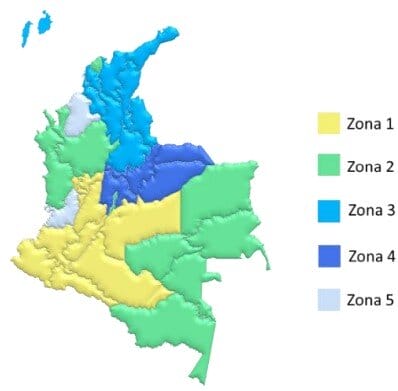
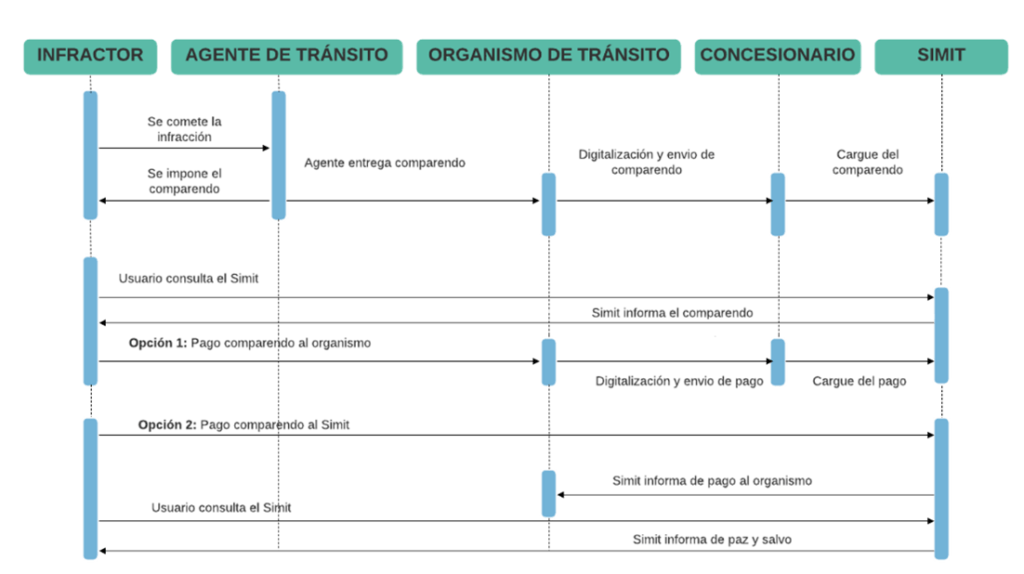
SIMIT (Integrated information system on fines and penalties for traffic violations) is a system that feeds the data reported on fines and penalties for traffic violations, provided by each of the Territorial Transit Authorities and which are delivered to each of the Simit Operation Concessionaires of the different zones (5 operational zones and 1 virtual zone) into which the country was divided. All territorial transit authorities are responsible for ensuring the timeliness in the delivery, integrity, veracity and quality of the information provided.

In order to contribute to the improvement of municipal income, Law 769 of 2002, in its articles 10 and 11, created SIMIT and empowered the Colombian Federation of Municipalities - FCM (a non-profit legal entity, of an associative and union nature, governed by private law) as administrator of the system.
There is a SIMIT office in all the offices of the transit and transport agencies of the territorial entities or in those where the FCM considers it necessary, in order to obtain information for the national consolidation and to guarantee that no procedure is carried out that is the responsibility of the transit agencies where the offender is involved in any capacity, if he is not in good standing.
Resources needed for SIMIT operation
Personnel, computer equipment, Simit Software (in charge of the virtual zone operator as well as the comprehensive management of the system's hosting and database), payment information for traffic offenders, electronic capture devices, electronic kiosks, breathalyzers, mobile service units, complementary software, communications infrastructure and technical documentation (manuals, instructions, procedures, others).
Entities participating in the operation of SIMIT
Colombian Federation of Municipalities (FCM): Simit Administrator.
Territorial transit authorities: The following are understood to be traffic authorities, in order:
1. The Minister of Transport.
2. Governors and mayors.
3. Departmental, municipal or district transit agencies.
4. The National Police through the Directorate of Traffic and Transportation.
5. Police Inspectors, Traffic Inspectors, Mayors or whoever takes their place in each territorial entity.
6. The General Superintendence of Ports and Transportation.
7. The Military Forces.
8. Traffic and Transportation Agents.
Municipal and Departmental Treasury Secretariats: Municipal, District or Departmental Administrative Units whose function is to guarantee the sustainability of the administration's finances.
Dealers: Firms selected by FCM through a public tender to develop, configure, implement, update, repair and operate Simit, in accordance with applicable legal and contractual requirements.
National Police Traffic Department.
Data Storage Service Provider (Hosting): It is the responsibility of the Virtual Zone concessionaire and provides the specialized service that supplies the main and contingency infrastructure for storing and processing all the information that is reported to the Simit database.
Financial Institutions: Entities with which the Colombian Federation of Municipalities has signed a national collection agreement, which are supervised by the Financial Superintendency.
Supervision of Operation Simit: Firm contracted by FCM through public tender to carry out the supervision.
National Single Transit Registry – RUNT: RUNT includes eight registries, including the National Registry of Traffic Violations.
Comprehensive Care Center – CIA: These are establishments that provide school and prison services for the rehabilitation of traffic code offenders, which can be operated by the State or by private entities.
Basic processes of SIMIT
The basic Simit processes necessary for effective operation are seven (7), which are stated below:
1. Training of traffic authorities.
2. Loading, processing and updating information.
3. Record of payments, distribution and transfers.
4. Consultation, service and attention to citizens.
5. Payment agreement process.
6. Transfer monitoring process.
7. Process of identifying reconciliation items.
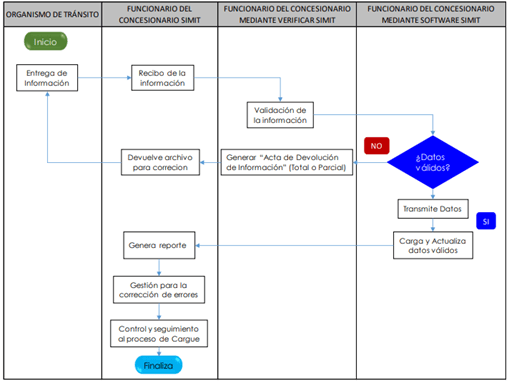
Source:
Law 769 of 2002, which issues the National Land Traffic Code
Law 1383 of 2010 amending Law 769 of 2002 – National Traffic Code

Natalia Valero
New Projects Analyst
With an eye on the development of smart mobility